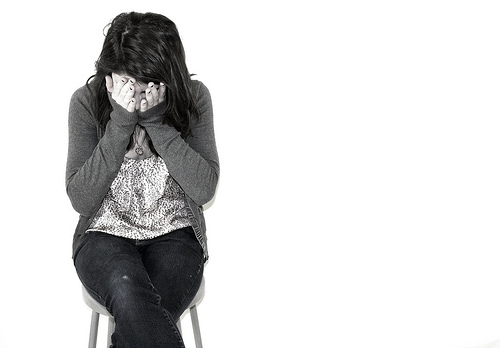
It’s hard to breathe. My veins feel carbonated; tiny bubbles with that same slight burn throughout my limbs and torso that I often feel against my tongue when drinking soda. I’m slightly disoriented, as if my airy blood is trying to make me float. My forearms are light. They can’t help but rise up toward my face. My chest is pounding. I must breathe. Just for a minute. I don’t want to do anything, think anything, feel anything. I just want to sit and breathe, very still, with my face buried in my hands.
I know it’ll pass. It always does. I just wish I could get through a day without freezing. Without feeling rising memories and having to involve my whole body to keep those thoughts at bay so I can focus on work, family, paying bills, doing dishes…
It’s hard to keep up with simple daily life when I must drop everything, without warning, and breathe for half an hour. But I do it. I must keep going. I begin my DBT exercises.
The floor is beneath my feet. I can feel the floor. The iPod is playing in my daughter’s room. I notice the song. I notice my daughter is humming to the song. The room is warm. I can feel the temperature of my skin, sending signals that the room is too hot. I open my eyes. In front of me is my coffee cup. It is solid. It is blue. It has a flower pattern. It is empty. I can smell overripe bananas. I remember that I meant to toss the bananas out this morning. My head turns toward the kitchen, and..
I’m out of it. I rise naturally toward the kitchen, not dizzy, not scared. I feel myself again. I toss the bananas, wrap up the trash and easily lift it to the front door. Okay, back to my day.
I was trembling from the time I left my office, through the cell phone calls from my car trying to find help, to the time I pulled into the garage of the medical office park. I felt physically sick and lightheaded, and my emotions were swinging from anger to trepidation to relief and back. I was going to get to talk to someone and get this all out of me, and everything would be back to normal tomorrow. I locked up the car and headed to where I thought the entrance was for the Capital District Psychiatric Center. Every step was a struggle. I wanted to sit down in the middle of the road and just cry. But I made it to the building and, after a little confusion, found the right entrance. The door was locked, so I pressed the buzzer and waited, wishing there was a bench to sit on.
The unprepossessing entrance was opened by a wary face who only let me in as far as the vestibule, his eyes looking me up and down as if I could be hiding a weapon. I lifted my eyebrows, a bit surprised, and he explained that they had to be very careful about what went past those doors. He asked my purpose, and made sure I understood that if I admitted myself, I couldn’t leave until the doctors gave permission for me to leave.
I didn’t see a problem with that – I knew I wasn’t a danger to myself or anyone else, I just needed to talk to someone and I couldn’t wait six weeks for a regular therapist to be available. I was sure I’d be out in a few hours, so I signed the book and let him look through my purse, and then he unlocked the next door and let me in, locking the door behind me.
I had never been in an emergency room like this one. Being locked in made me apprehensive enough, but the place was dingy. An old box T.V. was attached up high in one corner. The wood and cloth chairs were bolted together and to the floor. There was only one wooden table with rounded corners, also bolted to the floor. The dull fabric looked stained. The glass door behind me had small lines running through it – some kind of security glass, I guess. It was cloudy with greasy fingerprints and smudges. I wouldn’t want to touch that door handle unless I was wearing gloves. There was another door to the left, locked with a small window at eye level, and a third door just like it straight in front of me. To the right was a reception area, with a staff person sitting behind more security glass. There was a long hallway to the right, with several gray metal doors with small windows.
Everything looked grubby, and there was an occasional waft of unwashed human bodies floating in the cold air-conditioned space. Curled up on a chair near the reception desk was a woman with unkempt hair, covered in a blanket up to her chin, sleeping. There was a litter of small brown paper bags on the chair next to her, and a half-eaten apple.
The staff person who admitted me regained my attention and took me through the door straight ahead. On the other side was a row of three closet-sized rooms, each with a table and a couple chairs. He gestured to one and explained that I would begin with some paperwork, and then there would be an initial intake interview. Then he left me alone with a pen and clipboard.
I pushed back my regret as I reached for the paperwork. Finally, something that made this place feel a little more like a legitimate hospital. Of course they’d get the money-part right. I filled in my insurance, took emergency contact numbers out of my cell phone, and was just finishing up the last form when a man and a woman walked in, smiling their welcomes.
I shook their hands and they walked me through the next steps. One was a social worker, the other a staff member trained in peer counseling and emergency aid. They were both kind and intelligent, so I relaxed a bit, ready to trust the process. The relief started to outweigh the trepidation.
When they asked why I was here, I gave them the short version first as background. I was abducted by a parent at 3; we were always on the run – went to 5 elementary schools; she beat the hell out of us with a metal cooking spoon and whatever else she got her hands on; I was a teenage runaway; I got pregnant and married at 19; that marriage ended with me in the hospital and him in jail; and my real father found me when I was 21; that I’d been having nightmares my whole life.
Then I told them what was new that brought me in here: that my step-father had died the week before, and I went to visit my estranged mother at my sisters’ request. That my sisters and I had gotten to talking, and that one sister revealed she had been raped – in our mother’s presence – when she was 9 years old. And after that I began having memories I had never had before. That I was afraid I might have been there when it happened. That I was so angry and had all these emotions I was struggling to control. I told them I just needed to talk to someone and get it all out because I felt completely wrong, like I would explode if I didn’t do something, anything.
They asked me if I had ever contemplated suicide, and I told them of course, just like anyone else, but I wouldn’t do it because I have two children I’m responsible for. That worried them at first, but once I explained that Demi was 29 and Daisy would be 16 in a few days, and that Demi and my ex-husband could take care of Daisy in my absence, then they were reassured. I did say that sometimes I thought that if I could just hang on for two more years, until Daisy went to college, then I could go away, perhaps forever. And that was partly why I was here, so I could make it the next two years, because the way I had been feeling and acting this past weekend, since Meg’s revelation, I wasn’t sure I could make it two weeks, much less two years.
As I’m writing this, I realize how dramatic that sounds, but when I was facing those two people, I didn’t want to hide anything. I wanted help, real help, so I quietly told them the truth. I tried not to cry, but I did reach for a tissue and did my best to keep my cheeks dry and speak calmly. I wished ruefully that someone else would take care of me for awhile. I have been taking care of someone else since I was six years old. I was just so tired, too tired to be a strong, normal, responsible person anymore.
They took plenty of notes but still managed to give me their full attention. They made me feel like they really heard me and they cared. I felt like I was finally going to get help. They said I would need to wait in the waiting room for a little bit, while they reached out to my primary care physician. They also took my purse and cell phone, apologizing and explaining that they would be locked up safe and that they couldn’t have those things in with other patients. They would try not to be too long and would come back to me with some next steps.
So I went back out to the waiting room, relieved and obedient. An hour later, I was a little impatient but amused. Just like a hospital, the wait is always longer than the doctor visit. I watched other patients come and go, some staying with me waiting. A couple of them spoke with me, freely telling me their stories. I have a neon sign on my forehead that says “I want to hear your life story” and often people obey that sign, even if all I want to do is crawl under a rock and deal with my own problems.
I was surprised to still be in that small room with people who were quietly rocking or walking and talking to themselves at 5 p.m., when they handed out brown paper bags of cheese sandwiches and applesauce. I asked if I could call my daughters at that point, because they were expecting me home from work soon. They let me get the numbers off my cell phone, but I had to wait while someone fetched it, then I had to keep my hands and cell phone inside the tiny window on the receptionist’s desk. No cells allowed for a single second in the waiting room. I used the landline provided for patients to call my girls and explain where I was. I promised I’d call them as soon as I knew anything further.
I went to use the bathroom and immediately knew I had made a mistake. No way did I belong in this place. This wasn’t a hospital, it was a minimum security prison. There was a shower in there with a torn black curtain and a floor that was too grimy for bare feet. There was toilet paper but no trash can and no paper towels and no mirror and – what was worse – no lock on the door. I went back to the receptionist to explain I was on my period but there was no trash can, and he told me I had to wrap my ladies things in toilet paper and put it in the cardboard box of trash under the TV in the waiting room, the worst place for privately throwing something away because the whole room was facing that direction. He handed me a tiny bar of soap, like what you’d get in a hotel, and a rough white washcloth he said I could use to dry my hands. He said to just leave it in the bathroom.
I was in that waiting room a total of seven hours before one of the intake staffers spoke to me again. By then, my anxiety was higher than it was when I had walked in.
I have many more good days than bad days, now. Today is a little in-between. It was hard to write last night’s post. I do get frustrated with myself for having bad days at all, and to those who believe I lose credibility by telling this story, well, part of me agrees with you. It was nearly 40 years ago, for heaven’s sake. I’m perfectly safe, have been safe for decades. I’m a professional and a mother, with many responsibilities. I have other things to do with my time than relive memories I never knew I had. I don’t have time for numbness, staring into space, feeling fear rush through my veins for no reason, or getting persistent pokes from unwelcome memories at inconvenient times. I just want to shake myself and say “get over it, already!”
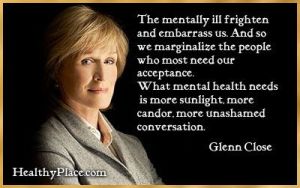
The most pernicious thing about stigma is that many of us with PTSD, or other mental health issues, actually buy into it. We stigmatize ourselves just as much as others do. I don’t need someone telling me to get over it because I tell myself that almost every day. When I came back to work and found no flowers, not even a welcome-back or get-well-soon card from my coworkers, I wasn’t surprised. I had been in a mental hospital for a month. No one gets flowers in today’s world for that.
If I had been in the hospital a month with a broken limb or appendicitis or something, I would have been welcomed back warmly. Instead, there was very little acknowledgement that I had been gone at all. Where I had been or why were questions that were studiously avoided. I have no idea what people did or didn’t know. I am grateful for the coworker that gave me a hug, and the other one who took me to lunch that day, but I don’t mind admitting that it would have made my return much easier if there were some daisies or something on my desk to let me know I had been missed, that people cared that I was okay. Instead, I felt like I had let me team down by being gone so long, so jumped into work like nothing had happened so I could pick up my slack. I kicked myself for being silly over a stupid thing like a get-well-card.
Logically, I know it’s not inappropriate to wish I had been more warmly welcomed back. I know that it’s normal to struggle over these new memories. My emotions and unconscious acceptance of social stigma aside, with everything I’ve been through it would be no surprise if I were still in the hospital now, five months later. Think about it. I am a person who has known more violence in the first 25 years of my life than most people ever experience in a lifetime. I had come to terms with all that, had accepted it and moved on, and even helped others. Now to find out that on top of everything else, I had been raped as a child? And one of my sisters, too? And that my mother – probably due to her own struggles – allowed these things to happen, and was even present? That there may have been drugs involved?
I think it’s understandable for me to have felt that enough is enough. I’ve had more than my fair share, and last June I needed to stop the world and get off for a bit. The important thing is that I got back on the world, and relatively quickly, all things considered. Sure, it’ll be several more months before I’m completely back to normal, whatever that is, but I’m happy and working and taking care of my family and setting great future goals.
Growing up the way I did, it’s a miracle I’m not in jail, a junkie, an alcoholic, a prostitute, or dead. I beat the statistics. How many teenage runaways go to college and graduate with honors in just three years? How many children who grow up in households with 15 years of recurring, unpredictable violence are able to break the cycle and successfully raise smart, healthy, happy children of their own?
I want to be the best possible mother to my girls. I want to have mastery in my career and be a pillar of strength to the people in my life and my community. I did the right thing by checking myself into the hospital, so I could achieve those goals. I stand by that decision.
Of course I will continue to have good days and bad days for awhile. This is all still relatively new to me. Of course I should continue to reach out for help with my mental and emotional health, as much as I do for my physical health. That’s what a responsible person does.
One day, regular mental health checkups will be as normal and commonplace as regular physicals. One day, our healthcare system and insurance companies will realize that humanity is a sentient species, much more than just physical mammals, and our healthcare should reflect that.
Meanwhile, I’ll keep writing about my experience with PTSD both in and out of the hospital. Hopefully, this inside view will help people understand and accept that it is normal and expected that a human being will have mental health issues. Hopefully my story will help the movement to end the stigma. After all, silence is the enemy of change.
Do not read this post if there is any chance that you can be negatively affected by reading about sexual assault.
Friday July 11, 2014 around 8:50 a.m.
I was on 787, driving to work, half-listening to Marketplace on NPR. Traffic was busy but steady, and I anticipated a light day at the office. I was thinking about the therapy session I had the evening before – EMDR (Eye Movement Desensitization and Reprocessing), which I was told is a psychotherapy that enables people to heal from the distress of disturbing life experiences faster than traditional therapies. Try anything once, is my usual motto.
The therapist had me put on a set of earphones connected to something that looked like a Walkman. It played a series of beeps, first in one ear and then in the other. Then she had me recount one of my memories. I told her about the time my first husband tried to strangle me.
It may seem odd, but I’ve had the memory so often and it’s appeared in nightmares so regularly that I’m really not bothered by the story anymore. It was a long time ago, and it’s only useful for advocacy purposes now. I told her the story just as easily as I’ve shared it at speaking engagements in front of women’s groups over the years.
Nothing happened. I pondered that now, as I was driving. I had felt a little silly, wearing the headphones and hearing those beeps while talking about a serious topic. It felt a little like it was minimizing what happened to me, making light of it. Maybe that was part of the point. I remember thinking that I would be uncomfortable listening to those beeps while recounting my most recent memories – and then there it was.
Just like that, in the middle of the highway, I remembered. The memory I had been fighting against, ever since my sister told me about her memory six weeks ago, was suddenly right there. I saw his face, I knew I was on the couch in our house in California, and I knew what was about to happen.
I shut down my mental white walls quickly, glancing in all my mirrors at the traffic, grounding myself in the present. My heart was pounding, and I was shivering to the point that my teeth were chattering. I started counting the cars I could see in the traffic, carefully noting where they were and any shifts in speed and lanes. I listened carefully to everything being said on the radio, as if I would have to recite it later. I could smell the cold in the air from the air conditioner. Part of the DBT training we had in the hospital taught us that noticing every little thing around us can help keep us in the present.
It all happened so fast, and my reflexes kicked in the same way they do if I sneeze while driving and involuntarily close my eyes. Just like a sneeze, the glimpse of the memory appeared and shut down, and I was driving as if nothing had happened. I couldn’t stop shivering, but the steering wheel was solid under my grip, I was breathing normally, seeing normally, driving normally, and I made it to the parking garage without incident.
Once the ignition was off, I leaned my head on the steering wheel, gripping it as if it were a lifeline. DBT be damned – I was safe now, and by God I needed to know what happened.
TRIGGER WARNING
I was on the brown sofa in the living room on Cass Avenue. I know I was 10 years old because that was my age in that house. There was music playing. A record dropped with its soft plunk, and music played. He was in front of me, smiling and stroking my hair. I kept trying to turn my head to look around the room, but he placed a hand on my cheek to keep my head from turning. He told me I was a good girl, a sweet, pretty, good girl. He asked me if I liked him, and I nodded.
With one hand on my cheek, keeping me still, his other hand traveled all over me. He asked if I liked how that felt. He slipped a hand inside my panties, then pulled them down, all the while whispering what a good girl I was.
I remember I was trembling, uncomfortable and confused. This was mommy’s friend and I knew she would be mad if I wasn’t nice to him. I didn’t understand why his hands were on me, but it didn’t hurt, and he was very nice to me, so I didn’t do anything. Then he put a finger inside me, and asked me how that felt.
I was so surprised, I couldn’t say anything. I didn’t know there was an empty spot there to put something in. He moved slightly, and I felt this strange warm glow down there. I could feel my eyes were very wide, and I looked down at what he was doing. He was naked. I don’t remember him taking his clothes off. I saw his pee-pee, and quickly looked up away from it. He laughed softly, as if he were trying to stay quiet.
He took his hand from my cheek and slowly pushed me back on the couch. His face was inches from the top of my hair and I thought for a minute he was going to kiss my forehead. I could almost feel the short, scratchy hairs from his chin. Then he took his hand away from below, and I could feel something bigger pressing there.
Then there was a blinding pain, like I was being ripped open, and I opened my mouth to scream. He quickly put a hand over my mouth, and the pressure and my thrashing made my head turn to what he didn’t want me to see.
My mom was asleep on the big, round papasan chair. Her hair was messy, all over her face. She was in her long, furry robe. That’s right, it was cold outside. I could see part of the fireplace hearth, and there was some silver tinsel leftover from Christmas laying there. The tree-table was between me and mom. She didn’t hear me. She didn’t know I needed her. The table was between us, that big slice of a tree trunk, polished and glossed, where I had spent many lazy afternoons counting the rings. The table was littered with beer bottles and filled ashtrays, but one spot was cleared off and only had some uneven lines of white powder. There was music playing.
That was it. The memory abruptly ended, leaving me hanging like the flipping of broken film at the end of a movie reel. I slowly left 1975 and realized my hands were hurting from gripping the steering wheel so tight. I threw back my head and gulped huge mouthfuls of air.
I felt a dozen emotions crowding in on me, all clamoring for attention. I was frightened. No, I was remembering feeling frightened. I was in disbelief. How could I possibly not remember that happening? How could I go forty years, and be unwaveringly positive in all that time that I had never been sexually assaulted as a child?
And no way were there drugs in the house. I never remembered such a thing. There were no hints of it in any of my regular memories – except that time I flew back to California to visit friends when I was in seventh grade in Kansas City. My old friends from California took me to a party where there was a bong being passed around. I didn’t touch it – I was too nervous and we thankfully left quickly. I guess it was more prevalent there than it was in Kansas City. Whatever. This memory was wrong. It had to be wrong. It wasn’t real.
And I was angry. Over everything else, I was incredibly angry. I grabbed the steering wheel again, lowering my head and screamed at it, forgetting for a moment that I was in a public parking garage. The sound snapped me out of it, and I remembered I was supposed to be walking to the office. I gathered my things and got out of the car, automatically being the good girl, going to work and doing what I was supposed to do, but I saw every detail of his face the whole way.
I made it to the bench outside the Assembly side elevators in the Capitol building, and sat there, trying to slow down my heart and breathing and do my DBT drill. I dug out my phone and called my therapist. No answer. I left her a lengthy voicemail. I sat wondering who else I could call. Then I remembered a friend of mine had been a child advocate in the court system. I called her, and she knew exactly what to say. She made me get a peppermint out of my purse. She made me touch the floor and describe what I felt. She walked me through my DBT until I felt silly for getting all worked up over something that happened forty years ago. I set my head straight, got up, got on the elevator, and went to work, being the responsible person I was supposed to be. But I was still quietly angry.
Jo, 1970, Simi Valley, CA. Two years after being taken from New York City and under a different name with a new birth certificate. Missing for 18 years. Listed with the National Center for Missing & Exploited Children. Found in 1986.
I am touched by the very kind emails and posts I’ve received, encouraging me to keep writing and publish. When we think of PTSD, we usually think of soldiers recovering from the horrors of the battlefield. I can’t possibly imagine what they must be going through, although I have more of an inkling now than I did this time last year. To just thank them for their sacrifice seems so feeble and inadequate. On the other hand, we don’t thank our servicemen and women near enough. I don’t want my story to take away from the vital importance of raising awareness of PTSD in the military and the need for funds for research and their continuing care.
But there’s another population with PTSD. There are children who grow up knowing more violence and pain in their first 15 years of life than most people experience in a lifetime. Those children become adults who are remarkably strong and incredibly fragile at the same time. Too many of them do not get help, and never reach their full potential. This is a “pick yourself up by your own bootstraps” nation. We don’t talk about mental health issues. We deny there’s a problem. We grin and bear it. We keep a stiff upper lip. Shame on those who don’t.
These attitudes negatively affect government and private funding. The research is not near as far along as it could be, and new studies raise more questions than answers. Apparently, my children could be genetically affected by DNA affects that my PTSD may have done to my genes? Yeah, I’d kinda like to see another study clarifying what the heck that’s all about. There’s a few million of us who’d like to see more research. According to the National Center for PTSD, about 5.2 million Americans have PTSD during the course of a given year.
But my story is not just about the sudden onset and resulting treatment of PTSD. It’s about child abuse. It’s about domestic violence. It’s about parental kidnapping, rape, and sexual assault and molestation of children. And it doesn’t include other common factors of trauma in children’s lives: gang violence, homelessness, and hunger. I grew up in middle-class privilege, and still experienced the kinds of violence that America thinks only happens in impoverished inner cities. Much as I want to raise awareness that childhood violence occurs in the suburbs, I absolutely don’t want to take away from the fact that we should be doing a better job of addressing it in cities, too. We should be doing a better job addressing it worldwide. It shouldn’t hurt to be a child.
I know who I’ve been. I don’t know who I’m becoming. I do know that I’m changing a little bit every day through this process of shocking realizations, acceptance, and healing. I do know that treatment for non-military PTSD is still filled with guesswork and trial and error. I know that not one professional has pointed me in the right direction, to the right type of treatment, and I have to kiss a lot of frogs to find what will work for me.
I’ve been involved in public policy for the last twenty years. It’s so ingrained in me that I cannot sit in a therapy session without thinking of the larger ramifications of treatment and public health. I met a reporter in the hospital, and he told me he was thinking the same thing. Whatever’s happening to us, we may as well have it happen for a reason.
My story is not uncommon. There are many of us trying to figure out where to go for help, keeping it secret from the workplace, and keeping a stiff upper lip while we search. I hope writing about it will encourage others to seek help; encourage people to call their legislators and demand increased funding for research and care; and raise the level of conversation in this country about the importance of addressing mental health. Perhaps, one day, an annual mental health checkup will be as common and expected as an annual physical. Maybe my book will help make these things happen. Maybe that reporter I met will write about it and make change. Something good has to come from all this. Cross fingers.
If you share any post, I hope you share this one. Thank you for taking the time to read it, and a special thank you to all of you who have sent me your kind words and prayers. I am truly touched.



 Erase and Start Over